

 English
Green Social Prescribing: Where Healing Meets the Outdoors
Across Canada, family doctors are writing a curious new kind of prescription—and it doesn’t come in a blister pack. Instead, the “dose” might be an allotment in a community garden, a volunteer shift planting trees, or a weekly walk in a local urban forest. This movement, known as “green social prescribing,” reframes how we approach mental health and wellbeing by reconnecting people to the natural environment around them.
In an era when so many Canadians spend more than 90% of their lives indoors,[1] this return to nature feels both revolutionary and refreshingly simple. If this sounds poetic and likely ineffective, the notions of fresh air and sunlight are gaining mainstream attention with a wave of new science—most notably a study from the University of York—showing that prescribed interaction with nature can be clinically effective, rivalling traditional psychotherapies like cognitive behavioural therapy (CBT).
Nature Joins the Treatment Plan
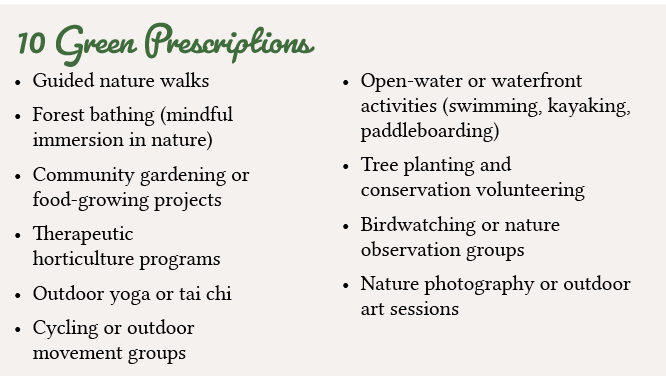
Green social prescribing directs patients toward community services and nonmedical interventions when facing issues like loneliness, mild depression, or chronic stress. The model has been formally integrated into primary-care systems such as the National Health Service.[2] Rather than reaching immediately for pharmaceuticals or therapy referrals, practitioners might suggest structured nature-based activities such as gardening groups, conservation projects, or “care-farming” programs where clients work alongside others to grow vegetables and care for animals.
Connecting patients with green spaces is complementary health—we’re treating the root causes of poor mental health, not just the symptoms.
Science Behind the Soil
Until recently, the therapeutic benefits of time spent outdoors were largely anecdotal, but the study from the University of York, led by psychologist Paul Coventry, provides robust scientific validation that nature-based activity is not simply a pleasant pastime: it can be clinically as effective as short-term CBT for anxiety and depression.[3]
Participants who engaged in structured green activities, specifically horticultural therapy and care farming, reported comparable improvements in mood, anxiety reduction, and life satisfaction after 12 weeks as those enrolled in conventional CBT programs. Follow-ups showed enduring benefits months after participants completed their programs, suggesting that cultivating a relationship with nature provides a lasting protective factor against relapse.
These findings build on earlier landmark research. A meta-analysis demonstrated that exposure to natural environments significantly improves mood and working memory.[4] Similarly, another analysis found that a 90-minute walk in a natural setting reduced rumination and neural activity in the prefrontal cortex, a brain region associated with depression.[5] Ulrich’s stress recovery theory and Kaplan & Kaplan’s attention restoration theory further explain how natural environments lower physiological stress and replenish depleted cognitive resources.[6], [7]
Physiologically, exposure to green space has been associated with reduced cortisol levels,[8] improved immune functioning,[9] and decreased sympathetic nervous system activation. As Coventry’s team observed, “the act of nurturing living things reintroduces purpose and mindfulness in a disconnected modern psyche.”

Canada’s Growing Nature Divide
Environmentalist David Suzuki once described modern urban life as “a grand experiment.” This research on the value of spending time in nature carries profound implications for Canada’s increasingly urban population. Over 80% of Canadians now live in urban centres according to Statistics Canada,[10] where access to meaningful green space is often limited. Many urban dwellers experience what some researchers describe as “nature deprivation,” associated with stress, cognitive fatigue, and emotional disengagement.[11] Every hour spent under LED lights rather than natural sky subtly erodes our biological alignment with natural rhythms.
Epidemiological studies suggest that people living in greener neighbourhoods report lower levels of depression and anxiety.[12], [13]
Green social prescribing doesn’t aim to whisk people away to pristine wilderness; instead, it helps them reclaim the nature already around them. A single raised bed in a community garden, a lunchtime gardening club, or a park restoration initiative can provide that missing link.
In Vancouver’s Downtown Eastside, pilot garden programs have shown promising improvements in participant wellbeing and social cohesion. Similar initiatives across Canada are aligning with international findings that community-based green programs enhance social connectedness while reducing depressive symptoms.[14]
Connection through Nature
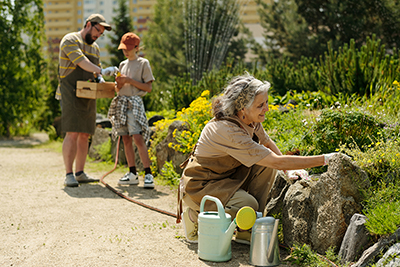
One of the subtle strengths of green social prescribing is its social dimension. Unlike solitary exercise or digital mindfulness apps, most ecotherapy activities unfold communally. Shared labour, whether planting bulbs or composting, generates what sociologists call collective efficacy.
For individuals dealing with depression or anxiety, these gentle, low-pressure interactions can counteract isolation. A study found that strong social relationships increase survival odds by 50%, underscoring the profound health impact of social belonging.[15] Green prescribing uniquely combines ecological exposure with relational engagement, a potent dual intervention.
Planting the Framework
The infrastructure for green social prescribing in Canada is quietly taking shape. Canadian municipalities in Vancouver, Calgary, Montreal, and Halifax are exploring partnerships between primary-care networks and parks departments.
Still, challenges remain. Sustainable funding, standardized referral pathways, and consistent outcome measurement protocols must be established before green prescribing can scale nationally. Importantly, nature prescriptions should complement—not replace—professional therapy or medication when clinically indicated.
The Power of Place
If we strip the jargon away, green social prescribing is about reconnection. It invites us to view the environment we inhabit not as passive backdrops, but as active contributors to wellbeing. The garden plot becomes a metaphor for the therapeutic process itself: growth rooted in care, attention, and patience.
In reintroducing patients to soil, seasons, and sensory abundance, health-care practitioners may be planting the seeds of a cultural shift—from consumers of health to cocreators of it.
So, the next time your doctor asks how you’re managing your mood or stress, don’t be surprised if you leave the clinic not with a prescription slip, but with a packet of seeds and directions to the nearest community garden.
After all, your next refill might just bloom in a garden plot.

Dr. Ludovic Brunel, ND
Dr. Brunel has 15+ years of experience as a naturopathic doctor and practices in Calgary. His approach has always been to improve health outcomes by relying on the best research available.
setonwellness.com
References
[1] Government of Canada. Air pollution and air quality in Canada. Updated 2024‑06‑04. https://www.canada.ca/en/services/environment/weather/airquality/air-pollution-quality-canada-index.html
[2] NHS England. “Social prescribing.” [No date given.] https://www.england.nhs.uk/personalisedcare/social-prescribing/
[3] [No author listed.] “Nature-based activity is effective therapy for anxiety and depression, study shows.” University of York. 2025‑04‑16. https://www.york.ac.uk/news-and-events/news/2025/research/nature-based-activity-therapy-anxiety-depression/
[4] M.G. Berman, J. Jonides, and S. Kaplan. “The cognitive benefits of interacting with nature.” Psychological Science 19, no. 12 (2015): 1207–1212.
[5] G.N. Bratman, J.P. Hamilton, and G.C. Daily. “The impacts of nature experience on human cognitive function and mental health.” Annals of the New York Academy of Sciences 112, no. 28 (2015): 8567–8572.
[6] R.S. Ulrich. “View through a window may influence recovery from surgery.” Science 224, no. 4647 (1984): 420–421.
[7] R. Kaplan and S. Kaplan. The Experience of Nature: A Psychological Perspective. Cambridge: Cambridge University Press, 1989, xii + 340 p., ISBN 0‑521‑34139‑6, ISBN 0‑521‑34939‑2 (paperback).
[8] B.J. Park, Y. Tsunetsugu, T. Kasetani, T. Kagawa, and Y. Miyazaki. “The physiological effects of Shinrin-yoku (taking in the forest atmosphere or forest bathing): Evidence from field experiments in 24 forests across Japan.” Environmental Health and Preventive Medicine 15, no. 1 (2010): 18–26.
[9] Q. Li. “Effect of forest bathing trips on human immune function.” Environmental Health and Preventive Medicine 15, no. 1 (2010): 9–17.
[10] Government of Canada, op. cit.
[11] R. Louv. Last Child in the Woods: Saving Our Children from Nature-Deficit Disorder. Chapel Hill: Algonquin Books, 2008, 390 p., ISBN 978‑1‑56512‑605‑3.
[12] J. Maas, R.A. Verheij, S. de Vries, P. Spreeuwenberg, F.G. Schellevis, and P.P. Groenewegen. “Morbidity is related to a green living environment.” Journal of Epidemiology and Community Health 63, no. 12 (2009): 967–973.
[13] M.P. White, I. Alcock, J. Grellier, B.W. Wheeler, T. Hartig, S.L. Warber, A. Bone, M.H. Depledge, and L.E. Fleming. “Spending at least 120 minutes a week in nature is associated with good health and wellbeing.” Scientific Reports 9, no. 1 (2019): 7730.
[14] World Health Organization. Urban green spaces and health: A review of evidence. Copenhagen: WHO Regional Office for Europe, 2016, 91 p., WHO/EURO:2016-3352-43111-60341. Available from https://iris.who.int/server/api/core/bitstreams/74006ead-650d-4fca-815a-f1ff53c1eea1/content
[15] J. Holt‑Lunstad, T.B. Smith, and J.B. Layton. “Social relationships and mortality risk: A meta-analytic review.” PLoS Medicine 7, no. 7 (2010): e1000316.