Think of your microbiome as a large, complex company made up of many specialized departments. Each department has its own role, but the organization functions best when its teams communicate and work together. In the microbiome, those “departments” are interconnected microbial communities, known as microbiotas, made up primarily of bacteria along with fungi, viruses, and other microorganisms.[1] Together, they help support and regulate many body functions, interacting closely with the immune system, contributing to certain vitamin production, influencing hormone and neurotransmitter signalling, and communicating with organ systems throughout the body.[2],[3] In fact, we could not survive without them. Still, when the balance or communication within these communities changes, the effects can be felt throughout the body. So, what shapes our microbiome, and how can we support it?
Our microbiome began at birth. If we were born vaginally, it was inherited directly from our mother. If we were born by C-section, it was acquired from exposure to surface bacteria. Over the years, it was influenced by diet, hormones, environment, health, and medications, until adulthood where it stabilized.[4],[5]
The gut microbiota is one of the most influential microbial communities in the body, communicating with and influencing many other body systems.[6] The nature of these communications depends on the type of bacteria in the gut microbiota. Different bacteria will send out different messages. Simply put, we can think of gut bacteria as beneficial, potentially harmful, or relatively neutral. Beneficial bacteria make useful products for the body like vitamins and substances involved in hormones and neurotransmitter signalling. They also help protect against infection and help regulate inflammation by keeping potentially harmful microbes in check. Harmful bacteria, on the other hand, can cause acute infection or contribute to chronic inflammation.[7] We also have neutral bacteria, which don’t have a significant effect on the body that we know of.
Naturally, we want more of the good guys and less of the bad guys. If our microbiome is less than ideal, then how can we change it? It is difficult to permanently change our adult microbiome, but we can temporarily alter the bacterial composition toward a healthier balance, as long as we keep repeating the steps we take to do that. The body will respond quite quickly to this continuous intervention, by improving the health of our microbiome. Once we stop taking care of it, however, the effect can wear off within days, with the microbiome reverting toward its baseline.[8]
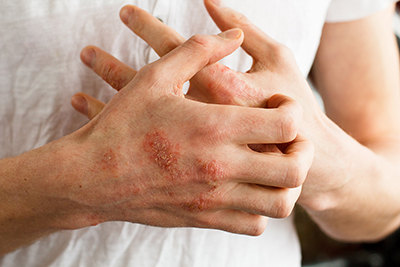
It’s pretty empowering to realize that we have considerable control over inflammatory states in our bodies to help heal disease. There are so many chronic diseases that have good research showing a reduction in inflammation and healing with an improved microbiome. Let’s take a look at one, eczema—an inflammatory disease of the skin—as an example. It’s a common condition, and one that a doctor may have given you a cream for. The cream works, but the eczema often returns once you stop applying it. Your gut communicates with your skin along the gut-skin axis.[9],[10] One way gut microbiota may influence the skin is through short-chain fatty acids, compounds produced when certain beneficial bacteria ferment fibre. These compounds can help regulate immune responses and inflammation and may also support the skin barrier.[11],[12] If we don’t have enough of the good bacteria, or enough of the short-chain fatty acids, inflammation persists.[13],[14]
We have two main goals for improving our gut microbiota. The first is to increase the numbers and diversity of the good bacteria.[15] The second is to provide these beneficial bacteria with enough material to break down so that they can make short-chain fatty acids and other products.
We can simply increase the number of good bacteria in the gut by eating fermented foods, which add to our microbial diversity, such as yogurt, kefir, and fermented vegetables.[16] The other way, which is a more targeted approach, is to take a probiotic supplement. With probiotics, you know exactly the strains of bacteria you are getting—certain strains influence specific health conditions more than other strains. You also know how much of the bacteria you are getting, something that can’t realistically be calculated through nutrition alone.
Probiotic supplements are delicate. Many of them are easily destroyed by your stomach acid and heat.[17] Make sure the ones you buy have been kept refrigerated from the time of manufacture through to use. There also needs to be a guarantee on the bottle that they will survive stomach acid to reach the intestines. A quality probiotic will also guarantee the amount of bacteria that will still be present by the expiry date on the bottle.[18],[19]
In addition to providing the gut microbiota with beneficial bacteria, you need to make sure they are properly supplied with source material. These are called “prebiotics” and are found through eating a variety of fibre from fruits, vegetables, whole grains, and beans. Your gut bacteria will break them down into molecules such as short-chain fatty acids, which help nourish the gut lining and communicate with the immune system and other organs. Ditch ultraprocessed foods, excess sugar, and alcohol, which may encourage a less favourable balance of gut bacteria and promote inflammation. The saying “you are what you eat” has never been truer! We need to eat a diversity of fibres every single day!
Although these are the two main ways to directly improve your microbiome, it is also key to keep an eye on your exercise, stress management, and mindset. Stress in itself can alter your gut microbiota.[20] Stay social. Remember that feeling well inside and out is beneficial to your microbiome.
Wendy Presant, RHNC, CFMP
A former registered nurse and a retired naturopathic doctor with credentials in health and life coaching, Wendy is passionate about helping people over the age of 40 optimize their continuing journey through life. She enjoys writing and is the recent author of Dry—A Holistic Guide to Sjögren’s Disease.
[2] J. Reynoso‑García, A.E. Miranda‑Santiago, N.M. Meléndez‑Vázquez, K. Acosta‑Pagán, M. Sánchez‑Rosado, J. Díaz‑Rivera, A.M. Rosado‑Quiñones, et al. “A complete guide to human microbiomes: Body niches, transmission, development, dysbiosis, and restoration.” Frontiers in Systems Biology 2 (2022): 951403.
[3] A.Shigehara, H. Kiyohara, T. Teratani, N. Nakamoto, Y. Mikami, and T. Kanai. “Gut microbiota and interorgan communication among the gut, brain, and beyond.” Internal Medicine 65, no. 2 (2026): 203–213.
[4] M.J. Blaser and M.G. Dominguez‑Bello. “The human microbiome before birth.” Cell Host & Microbe 20, no. 5 (2016): 558–560.
[5] H. Nunez, P.A. Nieto, R.A. Mars, M. Ghavami, C.S. Hoy, and K. Sukhum. “Early life gut microbiome and its impact on childhood health and chronic conditions.” Gut Microbes 17, no. 1 (2025): 2463567.
[8] S. Yan, J. Gao, and Q. Sun. “Research progress on colonization ability of probiotics.” Journal of Future Foods 6, no. 2 (2026): 195–204.
[9] M.F. Sanchez‑Lopez, P.A. Barrero‑Caicedo, H.M. Olmos‑Carval, A.F. Torres‑Medina, and J.P. Alzate‑Granados. “Relationship between skin and gut microbiota dysbiosis and inflammatory skin diseases in adult patients: A systematic review.” The Microbe 7 (2025): 100342.
[10] M. Jimenez‑Sanchez, L.S. Celiberto, H. Yang, H.P. Sham, and B.A. Vallance. “The gut-skin axis: A bi‑directional, microbiota-driven relationship with therapeutic potential.” Gut Microbes 17, no. 1 (2025): 2473524.
[11] R.‑J. Qie, J.‑B. Qin, H.‑Y. Wu, and Z.‑H. Ji. “Key messengers in the gut-nose axis: Mechanisms of gut microbial metabolites in the immunomodulation of allergic rhinitis.” Frontiers in Immunology 17 (2026): 1796775.
[12] B. De Pessemier, L. Grine, M. Debaere, A. Maes, B. Paetzold, and C. Callewaert. “Gut–skin axis: Current knowledge of the interrelationship between microbial dysbiosis and skin conditions.” Microorganisms 9, no. 2 (2021): 353.
[15] C.‑H. Tseng and C.‑Y. Wu. “From dysbiosis to longevity: A narrative review into the gut microbiome’s impact on aging.” Journal of Biomedical Science 32, no. 1 (2025): 93.
[16] E.R. Leeming, A.J. Johnson, T.D. Spector, and C.I. Le Roy. “Effect of diet on the gut microbiota: Rethinking intervention duration.” Nutrients 11, no. 12 (2019): 2862.
[17] S. Han, Y. Lu, J. Xie, Y. Fei, G. Zheng, Z. Wang, J. Liu, et al. “Probiotic gastrointestinal transit and colonization after oral administration: A long journey.” Frontiers in Cellular and Infection Microbiology 11 (2021): 609722.
[18] K. Fenster, B. Freeburg, C. Hollard, C. Wong, R.R. Laursen, and A.C. Ouwehand. “The production and delivery of probiotics: A review of a practical approach.” Microorganisms 7, no. 3 (2019): 83.
[19] R. Ferdousi, M. Rouhi, R. Mohammadi, A.M. Mortazavian, K. Khosravi‑Darani, and A.H. Rad. “Evaluation of probiotic survivability in yogurt exposed to cold chain interruption.” Iranian Journal of Pharmaceutical Research 12 Suppl. (2013): 139–144.
[20] J.C. Park, L. Chang, H.‑K. Kwon, and S.‑H. Im. “Beyond the gut: Decoding the gut–immune–brain axis in health and disease.” Cellular & Molecular Immunology 22, no. 11 (2025): 1287–1312.


 English